Rolling Green: How a leading tyre maker is cutting energy waste, costs and carbon
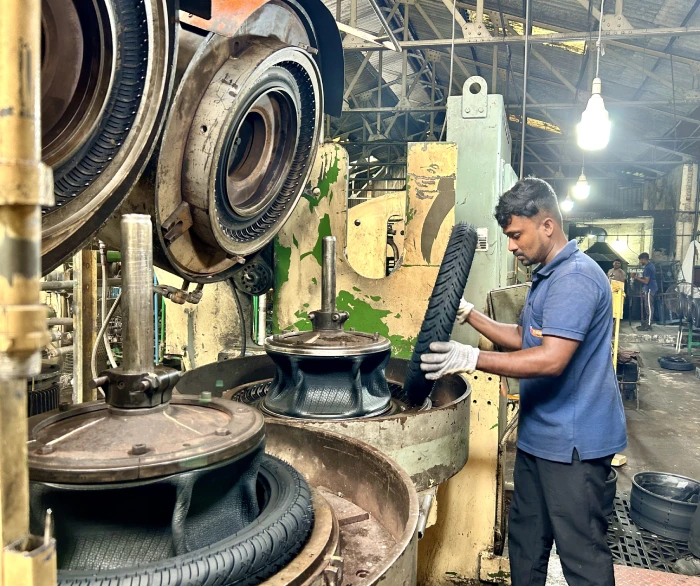
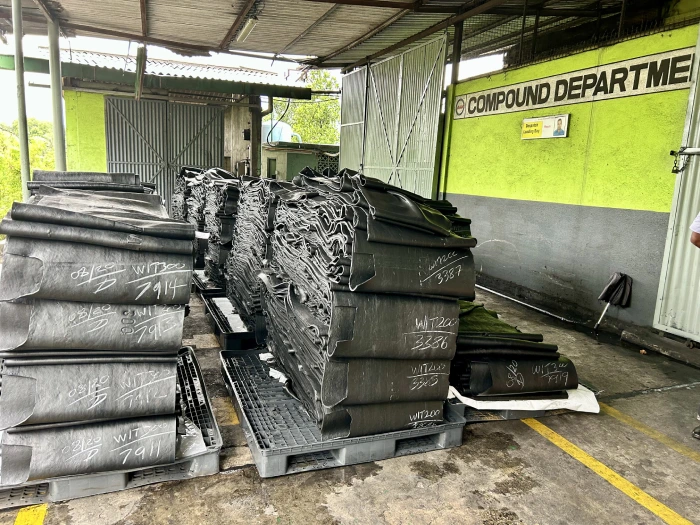
Mixing, sheeting, and cooling – the key steps involved in transforming Sri Lankan rubber into tyres for three-wheelers, cars, tractors, trucks and more. Since 1949, the production lines at Associated Motorways (AMW) have been following this tried-and-tested process. Today, the company is a leader in Sri Lanka’s tyre industry, serving local and international markets.
Credit: Small World Stories/Macarena Aguilar.
Damith Gamage is the Head of Production at AMW’s tyre manufacturing facility in Kalutara. He is responsible for overseeing the manufacturing operation as well as managing projects. “AMW produces 18,000 MT of custom rubber compound each year,” Damith said. The process uses high voltage machinery and tools leading to a monthly electricity cost of over 15 million rupees.
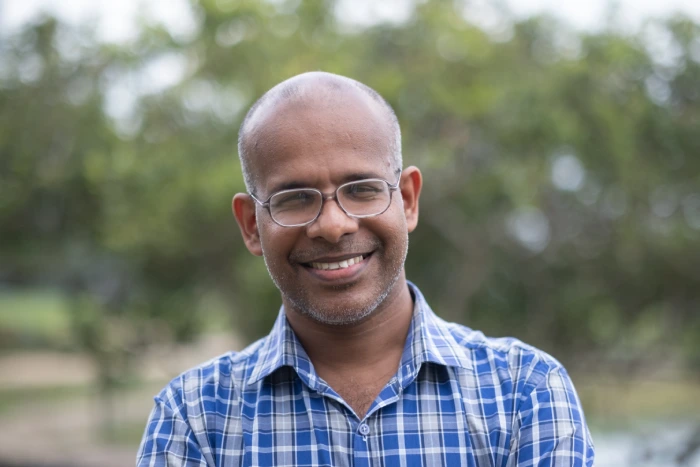
With Sri Lanka’s industrial sector still recovering from the energy crisis that crippled the economy in 2022, managers like Damith have been keen to find ways of reducing their energy bills. At the same time, the country is committed to tackling the climate crisis and companies like AMW need to support Sri Lanka’s goal of reducing industrial CO2 emissions by 7 per cent by 2030. “In the past, energy consumption was not a hot topic but now it is more important than ever,” Damith said.
Curbing energy waste
In 2023, Damith was among the first batch of 45 Sri Lankan trainees to successfully complete a one-year ISO-certified Energy Management Systems (EnMS) training course. The course was led by internationally-renowned United Nations Industrial Development Organization (UNIDO) trainers under the EU-funded Accelerating Industries Climate Response in Sri Lanka (AICR-SL) project, in partnership with Sri Lanka’s National Cleaner Production Centre (NCPC).
The EnMS training involves theoretical sessions, but also takes participants beyond the classroom to implement real-life projects in their places of work. “When assessing our energy efficiency, we identified the base load to be 22–25 per cent of total load. After identifying significant energy use, we have begun to reduce waste by increasing efficiency,” Damith said.
Credit: Small World Stories/Macarena Aguilar.
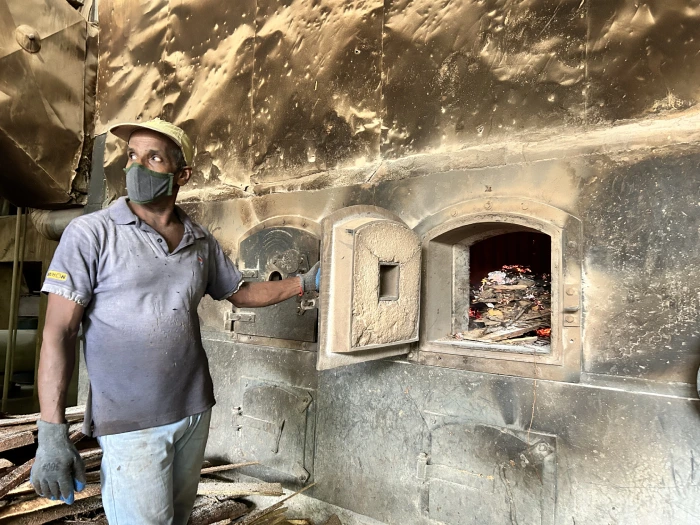
For example, initially, wood logs were utilized for thermal heating of the biomass boiler but after shifting to a mix of sawdust and wood as the factory’s main fuel, combustion efficiency improved from 35 to 42 per cent. “We also identified insufficient insulation in our steam production system, which we addressed by bringing in new condensation recovery processes; this led to a 5-7 per cent reduction in the fuel consumption of our boilers,” he said.
At the same time, maintenance plays a crucial role in ensuring energy efficiency in machinery, Damith said. “I have implemented a preventive maintenance programme that ensures all machinery is tuned for optimal energy efficiency,” he said.
A systems approach to motor efficiency
In factories everywhere motors use most (around 70 per cent) of the energy needed to drive production processes. Despite numerous improvements made over the years, motor-driven systems are still maintained and operated much the same way as they were 50 years ago. They are often run until they fail, and many operators lack the knowledge to gauge the health and efficiency of their equipment. Consequently, energy waste, unscheduled downtime and the resulting costs are all too common.
Credit: Small World Stories/Macarena Aguilar.
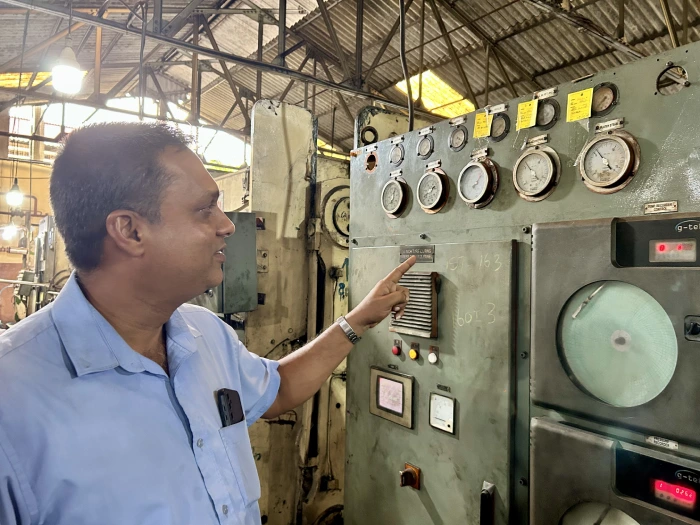
As motor systems play such an important role in reducing energy waste, Damith encouraged his colleague, Engineering Manager Chaminda Senanayake, to join UNIDO’s specialized Motor Systems Optimization (MSO) training course when it was offered under the AICR-SL project in 2023. “The course encouraged us to evaluate our entire motor systems, not just individual ones,” Chaminda said.
UNIDO has long championed a ‘motor-systems’ approach to achieving efficiency rather than focusing on the maintenance of individual components. This is because energy can be lost throughout the production process and these can add up to significant inefficiencies. “Typically, approaches that look at individual motors can result in energy savings of 3 to 5 per cent,” said UNIDO Energy Efficiency Expert, Rashindu Mendis. “Whereas a systems approach can deliver energy savings ranging from 10 to 50 per cent,” he said.
Varying motor speeds equals efficiency
Focusing on AMW’s Kalutara production plant, Chaminda and his team worked with UNIDO to identify and implement four projects. These were aimed at optimizing the plant’s air compression, cooling, and airflow motor systems. The project primarily involved upgrading the motor systems from fixed-speed operations to variable-speed drives, enabling motors to adjust their speeds according to demand rather than running at a constant speed.
For example, at the mixing stage of production, the plant’s mixer controls temperature using a cooling system with circulation pumps and a cooling tower. Water circulates at 35-37°C and is cooled to 33°C at the sump. Adjusting pump speeds optimizes energy use. Meanwhile, the team also achieved a drop in compressed air energy consumption by introducing a variable speed compressor and sealing air leaks.
Credit: Small World Stories/Macarena Aguilar.
Collectively, the four projects have resulted in a 10 per cent reduction in energy consumption. “I am very happy with this result,” Chaminda said. “But, we can save more and we are planning projects to achieve more energy savings across our motor systems,” he said.
Saving energy means changing minds
So far, by implementing the energy saving approaches from both the EnMS and the MSO training, Damith said that they have been able to reduce energy consumption and costs by 20 per cent. Reflecting on their energy saving journey, Damit says that the greatest challenge lies in changing mindsets.
“What we need is an integrated approach that works from the ground up; to build an energy conscious culture,” he said. “I use the monthly management meetings as my opportunity to draw attention to the progress of energy management initiatives: highlighting the gains and the savings that have resulted from our efforts,” he said. “We are now working to obtain ISO 150001 accreditation; to ensure the Company keeps moving forward.”
Related resources: