


New training equips industry professionals to lead on emissions reporting
As communities in Sri Lanka and around the world face escalating floods, extreme heat, and rising sea levels, measuring greenhouse gas emissions (GHG) has never been more crucial. Understanding where emissions come from and how to reduce them is key to effective climate action. A new training programme under the Government’s European Union-Funded ‘Accelerating Industries Climate Response in Sri Lanka’ project is empowering industry professionals to measure, report, and reduce greenhouse gas emissions—paving the way for a stronger climate future and greater economic competitiveness.
“This is the first structured training programme in Sri Lanka focused on building technical capacity for GHG accounting in the corporate sector,” said one of the lead trainers Dr. Sampath Wahala, who is also a Senior Lecturer at Sabaragamuwa University in Sri Lanka. “We’re delivering 120 hours of instruction, from the basics of climate science to hands-on tools for emissions calculation, reporting, and mitigation project design,” he said.
The training is delivered by national experts alongside international trainers from the United Nations Industrial Development Organization (UNIDO), which is implementing the project. Participants learn about global reporting and methodologies, carbon pricing and market mechanisms, among many more topics. They also gain exposure to product-level and organizational level GHG accounting and reporting, lifecycle assessments, and carbon offsetting strategies like forest carbon sequestration.
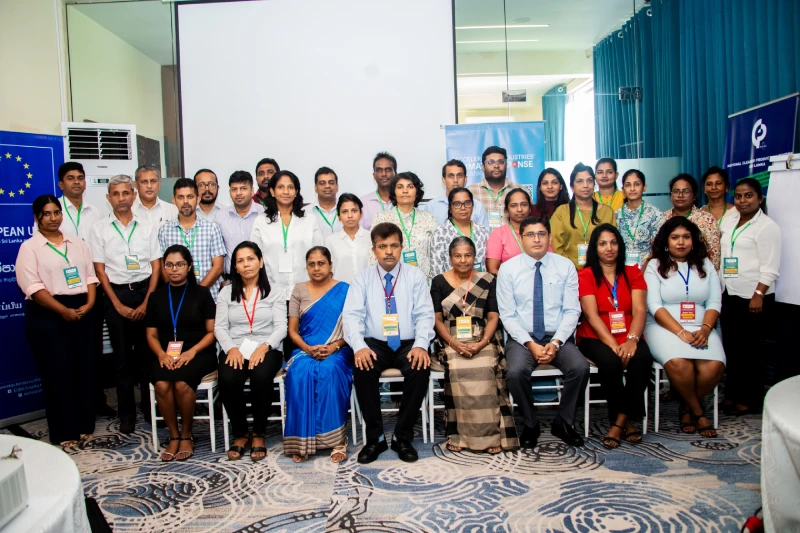
“The main idea is to develop competency,” Dr. Wahala explained. “We want these professionals not only to manage emissions in their own organizations but to become trainers themselves—to transfer this knowledge to others,” he said.
Data drought and reporting demands
Under its current 2030 climate commitments, Sri Lanka aims to cut industry carbon emissions by 7 per cent. According to Professor Erandathie Lokupitiya from the University of Colombo, industry emissions data, like data from all sectors, remains a major barrier to meeting climate goals: “We need time series data, we need it in the right format, and most of the time, we just don’t have it,” she said.
Professor Lokupitiya is a leading climate change and atmospheric science expert, who has made outstanding contributions to national climate action in Sri Lanka and internationally. As a resource person involved in the training, she brings a wealth of local and global experience to the course. “Equipping more professionals across industry and all sectors in emissions reporting will be critical for setting realistic climate targets and being able to make informed decisions about what actions to take to meet these,” Professor Lokupitiya said.
As the global stocktake under the Paris Agreement approaches, countries must prove they are on track. Programmes like this training—backed by government and industry stakeholders—are laying the groundwork for transparency, credibility, and action. “We’re not there 100 per cent yet,” Professor Lokupitiya said. “But the trend is there. And training like this is helping to push it forward.”
The Business Case
The market is already demanding climate transparency. “There’s pressure from outside—especially from the European Union,” said Professor Lokupitiya. “If you want to export, you need to be a green supplier and GHG accounting is now part of your competitiveness,” she said. But the benefits go beyond compliance. “Every GHG source in a company is tied to a cost center—electricity, fuel, raw materials and waste,” Dr. Wahala pointed out. “If you can measure it, you can manage it. This training helps companies reduce costs while reducing emissions. It’s a win-win,” he said.
And, while public discourse has often focused on emissions from power plants or agriculture, industry—and the corporate sector more broadly—is gaining attention as a key player in Sri Lanka’s climate strategy.
From the classroom to the real world
What sets the new training apart is its practical focus. Each participant will develop a real-world emissions reduction or reporting project within their own company or in collaboration with peers from other sectors.
In so doing, the training will confront some of the real technical hurdles that industries face. “For example, sometimes we’re dealing with informal or incomplete data systems within companies,” said Dr. Wahala. “Even measuring fuel use from a generator can be tricky if there’s no flow meter installed. It’s not just technical capacity—it’s about systems, finances, and awareness,” he said.
That’s why the training is designed to be flexible and inclusive, bringing together participants from manufacturing, hospitality, banking, services, academia, technical institutions and the public sector. “Some of them are starting from scratch,” Dr. Wahala noted. “Others come from companies already engaging in GHG management. So we use peer learning to bridge that gap.”
Building a cadre of experts
The GHG training got underway in April 2025 and will run through to September with 26 participants. It is part of a wider curriculum offered by the Project covering energy management systems (EnMS), energy system optimization and renewable energy, training hundreds of professionals across the public and private sectors. Collectively these courses are helping build a cadre of skilled experts in both industry and government who can spot opportunities, implement solutions, and carefully evaluate and monitor progress at every stage of the industrial sector’s decarbonization journey.
The practical suite of courses offered by the project run from six-months to one year. Engaging companies over a longer period means the training creates ripple effects as participants continue to apply and build on what they have learned. If they move jobs, they take these new skills with them and share them in another workplace. Staying connected with alumni and celebrating their achievements is also helping to build a strong and ever-growing network of energy efficiency experts across the country.