

Measurement is key to slashing emissions. Here’s how Sri Lanka is doing it.
To decarbonize its industries Sri Lanka needs to accurately track the emissions being produced and the actions being taken to reduce them. UNIDO is working with the Sri Lankan government, key industry players and energy experts to develop a monitoring, reporting and verification (MRV) system that will do just that. We spoke with Leon Bengsch at Gauss International Consulting, a climate change specialist working on the project, to find out more.
What is an MRV system?
For all countries it is mandatory to report on greenhouse gas emissions – what is called GHG inventory – and on policies and measures for mitigation to reduce emissions. What countries are ultimately aiming to do is reduce emissions. This is why every country has national determined contributions or NDCs [which commit to reducing emissions]. To be able to track NDCs you need an MRV system for all the mitigation actions, policies and measures. And this is highly linked to the GHG inventory because the inventory is the major data source for seeing how a country’s emissions reduce.
An MRV is also referred to as a transparency system. Under the Paris Agreement there is something called the enhanced transparency framework. Since COP26 it’s been agreed that every two years countries must provide biannual transparency reports, and for that they need a working MRV system.
What will Sri Lanka’s industrial MRV system cover?
Industry crosses the boundaries of the emissions categories that countries report on [the IPCC emission categories are energy, industrial processes and product use, agriculture, forestry and other land uses, and waste]. The MRV system that is being developed for Sri Lankan industry will encompass a GHG inventory for energy use in manufacturing as well as industrial processes and product use [IPPU]. The MRV tracking mitigation policies and measures in the industrial sector will only focus on IPPU, not energy use.
How is Sri Lanka’s MRV system being built?
This is not the first time that Sri Lanka has reported on GHG emissions … so we start with the raw emissions data that the country is already compiling and the arrangements that are already in place between stakeholders to move that data. And then we identify data gaps and analyse the approach that has been taken. Sri Lanka has been ambitious in the sense that it has been going to the plant level to measure emissions. But … it can be more resource effective to take a more aggregated, national approach.
How do you build the rest of the system?
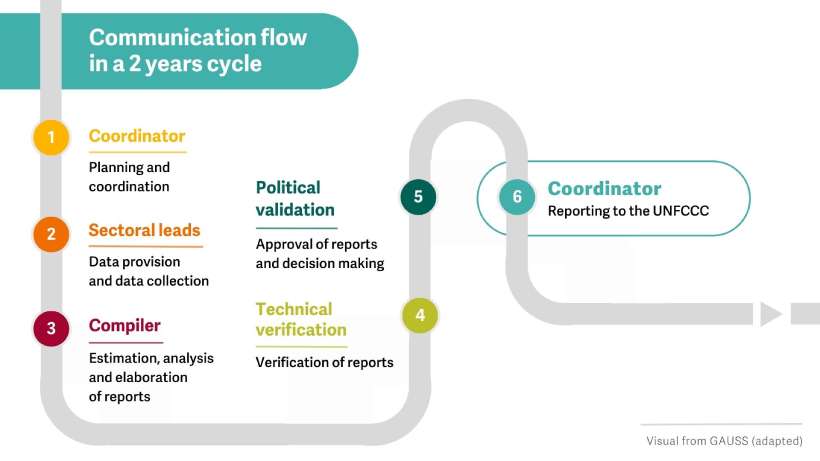
We start by identifying the key data providers, and from this we can then develop the institutional arrangements in a more structured way, where we add the roles and responsibilities of the actors involved. Data providers … could be companies, but often it is national ministries or statistical bureaus who already have extensive data sets. What we need is production data … fuel-use data and that data is centrally gathered.
Then you determine sector leads who gather information from the data providers for energy, IPPU … Then you select an organisation in the country that has technical capacity to do the data estimation, which is called the compiler or the estimator. Then you need technical quality assurance to verify the quality of the data … and you also need political validation. What you end up with is a streamlined process where the data moves from the bottom-up, gets quality checked at every step, until you reach political validation and then it’s ready for international reporting. This will happen over a period of two years, every two years from 2024 onward.
What stage is the project currently at?
Right now, we’re working with stakeholders to consult the proposal for institutional arrangements. This is the stage where the institutions and protocols are identified – Ministry A has to give Document X to Ministry B in month seven, that kind of thing. These are the key actors who will be actually operationalizing the system … so making sure that any proposed system fits with how they work and how they envision the MRV working is a priority. Then it will be a case of validating the institutional arrangements … then piloting the system with national stakeholders under a capacity building approach and using an IT platform.
What capacity strengthening has already been done?
In early 2023, information and capacity strengthening sessions were held with national stakeholders on the enhanced transparency framework, the GHG inventory and mitigation. There’s a lot of capacity in the country already. It’s just a bit scattered and the approach needs to be streamlined. But Sri Lanka is relatively advanced [in terms of monitoring].
Capacity strengthening will also be provided to the institution that will be the compiler … A coordinating entity will also be chosen … they will engage all the entities that are designated under the MRV … Their capacity building will be around how to implement the system so that the stakeholders in the specific roles know when they work and what they have to do.
Who are the key actors involved?
People who work on climate action within key ministries, determined by Sri Lanka’s Climate Change Secretariat, particularly in the Ministry of Industries and the Ministry of Power and Energy, with the Ministry of Environment as the centre point.
We work closely with the Climate Change Secretary, a senior figure in the Ministry of Environment, who maintains contact with three working groups that are now in place. There is an MRV working group, an industry support working group and a policy support working group, made up of experts from the most relevant ministries as well as important industry players. The working groups are cross-cutting. For example, when the data gets collected and estimated, ready to be verified technically, they will play an essential role.
Where will the MRV project be in a year from now?
The institutional arrangements will be fully designed, appropriated, piloted and validated and capacity building will have been carried out. …Ultimately, the aim is to ensure Sri Lanka has the full capacity to report on its climate action.